US Government Agency
Driving Data Interoperability Through Developer Experience (DX) Modernization
End-to-end redesign of an enterprise API platform for the public good. Research, systems thinking, and cross-agency alignment.
Overview
NOTE: Due to confidentiality agreements, some specific identifying details have been removed from this case study.
On this project, I improved the developer experience (DX) for an enterprise API, which provides data for millions of individuals who rely on benefits from a US Government Agency.
While working to improve the developer-facing portal, documentation, and resources, I also worked to improve DesignOps and ResearchOps strategy for our team to better provide secure, FHIR-compliant API access to data and form the backbone of a growing ecosystem third-party innovators.
The Challenge
The developer-facing portal, documentation site, and other resources for the enterprise API platform were visually and functionally fragmented, leading to confusion when new developers or organizations were attempting to onboard and access to the API.
Approach
Understand User Needs
- Leveraged analytics to identify drop-off and engagement points across public-facing sites as a starting place for targeted research.
- Conducted an accessibility and content audit of high‑traffic pages (based on page views) to prioritize features and resources.
- Led discovery research with current and prospective partner organizations to surface developer integration pain points and bottlenecks.
- Performed in-depth qualitative interviews with stakeholders to identify opportunities for cross‑unit data integration.
We started with a six-week research phase: interviews with 40+ users spanning all key audience types, a content and IA audit, and analysis of search patterns and common failure modes.
The key design decision: rather than a single homepage that tries to orient every audience simultaneously, we designed a progressive disclosure model that routes users to tailored experiences based on their role and task.
Rapid Prototyping
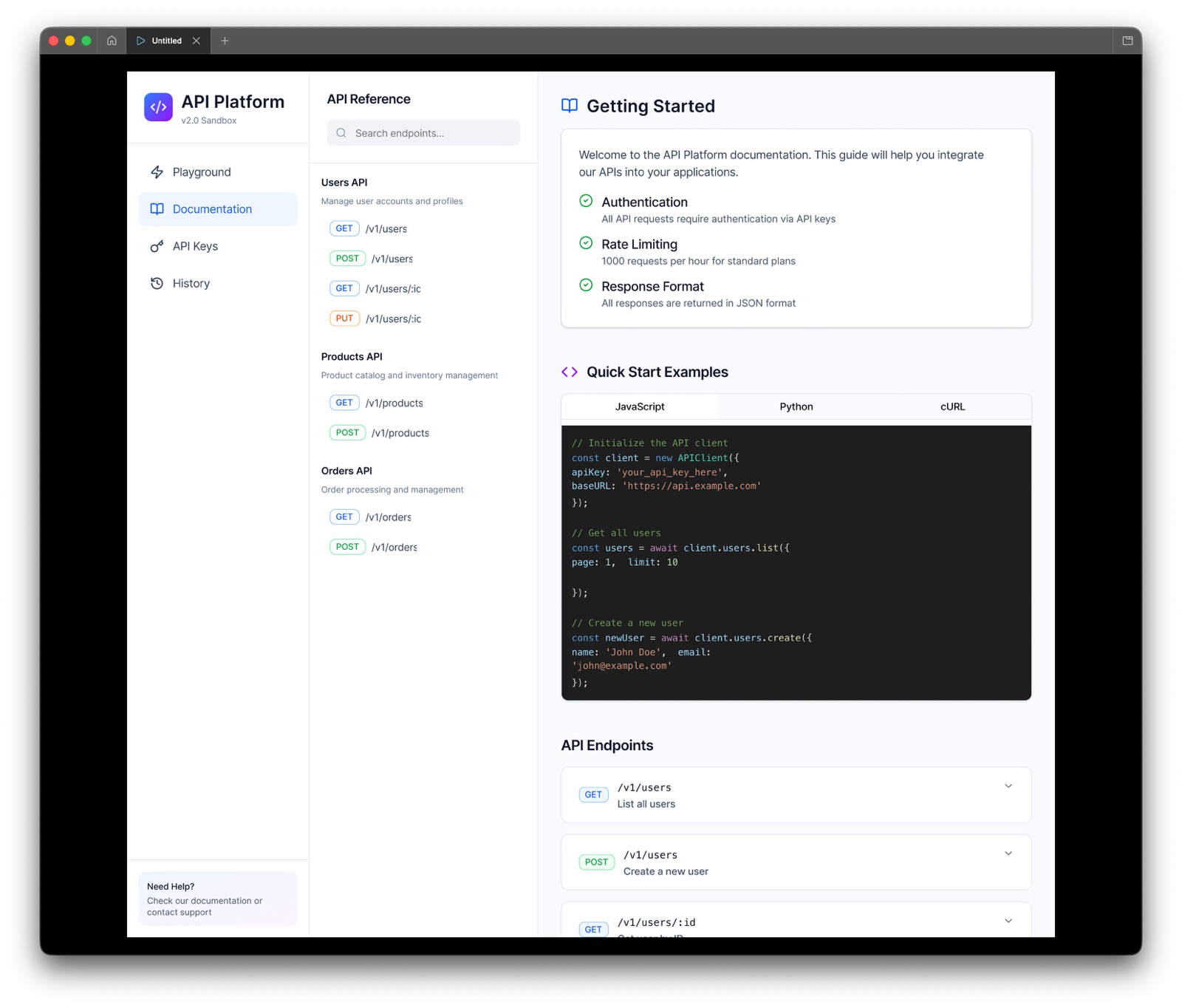
Based on analytics and user feedback, I rapidly developed prototypes based on a new an unified style guide and component library, leveraging elements from the existing agency design system to reduce duplication of effort and improve efficiency.
I developed of a mobile-first navigation system that gave developers more clarity and visual feedback about the Developer Sandbox environment and what functionality was present there, compared to the public-facing documentation site. This design allowed us to share front-end code resources for both environments and still have distinct elements with SCSS variable changes, rather than separate code for each environment.
Improved, Dynamic Developer Documentation
Originally, the documentation site was simply markdown text rendered as a static site through Jekyll. Our research with developers made it clear that they wanted a more dynamic approach, which led me to want to thoughtfully design a Swagger integration into our documentation.
This would allow developers to view the API documentation through the language of their choice and be able to see API endpoints and sample data dynamically, without our team having to spend time doing manual documentation copy updates.
Developer Sandbox Improvements
We streamlined the account creation flow that made it easier for developers to immediately get up-and-running with the API Platform, while also still collecting important organizational and demographic information.
We also created prototypes with several ways developers could complete interactions like copying API credentials for different applications they were working with, as well as explored embedding resources into the Developer Dashboard to help get new users up-an-running as quickly as possible.
Results
- Helped define metrics to quantify developer experience and watched that DX score increase by 32% after Developer Dashboard UI improvements (as well as documentation improvements)
- Elevated the HCD maturity across API platform teams through research enablement, shared practices, and consistent leadership.
- Improved user experience and adoption through actionable, research-backed recommendations and documentation enhancements, based on the time necessary to onboard new users and have them push their apps to production.
- Strengthened the agency's ability to deliver value through scalable, user-driven APIs by aligning technical excellence with human-centered insights.
Additional Results (Just Because)
Design and Research Ops Improvements:
- Created and facilitated a community of practice uniting design, product, and research professionals across the API ecosystem.
- Delivered targeted training workshops on accessibility, journey mapping, and community management to cross-contractor teams.
- Synthesized research into ecosystem-wide personas, standardizing understanding of user needs across teams and stakeholders.
Evangelizing HCD Practices:
- Built and shared HCD best practices with partner teams, elevating the maturity of research and design efforts across the API community.
- Collaborated with developers, product owners, and policy stakeholders to integrate research into iterative feature development.
- Led efforts to improve end-user documentation and onboarding processes, driving increased adoption and usability.
Integrated Agile Leadership:
- Worked alongside product managers, engineers, and client stakeholders to align HCD insights with Agile and SAFe workflows.
- Engaged in Program Increment (PI) planning, refinement ceremonies, and regular delivery check-ins to ensure stakeholder alignment and strategic prioritization.
- Defined North Star metrics and implemented OKRs to ensure continuous delivery of user-driven value and progress toward strategic goals.
Community and Developer Engagement:
- Partnered with a dedicated Developer Evangelist to capture developer needs and elevate them into the product roadmap.
- Led ecosystem-wide knowledge sharing through Scrum of Scrums, fostering communication across API teams and programs.