State Government Agency
Modernizing Compliance Through Automation & Service Design
Leading a delivery team tasked with a high-stakes compliance mandate in order to help hundreds of thousands of people keep their healthcare.
Overview
On July 4, 2025, President Trump signed H.R. 1 (One Big Beautiful Bill Act) into law, requiring states to implement Medicaid work requirements by January 1, 2027. In the state, approximately 750,000 residents will be subject to the new policy, and 310,000 could lose coverage due to new reporting requirements and more frequent renewal processes. Most of these losses will happen not because people are ineligible, but because the burden of complying is too high.
The state needs to design compliant solutions on an aggressive federal timeline for a policy and systems change that typically takes years to implement. At the same time, major portions of the policy have not been defined. Federal guidance from CMS is not expected until June 2026 – forcing the state to move forward amid significant uncertainty. Complicating matters further, this work unfolded during the longest federal government shutdown in U.S. history, which was simultaneously disrupting the state’s SNAP operations and stretching agency capacity.
The Task
My team was engaged to design evidence-based solutions to help the state implement Medicaid work requirements in a way that minimizes administrative burden and coverage loss. This involved:
- Doing discovery research to understand the people and processes most affected by the work requirements, including where confusion, burden, and inequities may show up
- Identifying and prioritizing high-impact opportunities to implement work requirements while reducing administrative burden and keeping eligible people enrolled
- Prototyping and testing solutions to ensure they are practical, equitable, and operationally feasible
Discovery Research
In collaboration with state staff, our team conducted qualitative and quantitative discovery research to identify the top challenges and opportunities to lower administrative burden and keep eligible people enrolled while implementing work requirements. The discovery research involved 3 workstreams: desk research, user research, and technical research.
- Desk research involved synthesizing existing research, operational data, and lessons from other states.
- User research involved conducting semi-structured interviews to understand the lived experience of administrative friction and compliance barriers. They took place with state staff acting as subject matter experts on policy, technical systems, and caseworker experience, managers and supervisors at local assistance offices, and community partners.
- Technical research involved engaging with state staff and vendors to understand the existing systems, data inventory, development processes, and security protocols.
Prototyping
Focusing on proactive outreach, the team mapped the end-to-end communication journey and developed prototypes for plain-language SMS notifications and reminders.
Remote usability testing with actual beneficiaries revealed that while the texts were understood, skepticism about links would still drive high call volumes to caseworkers as clients sought to verify the messages.
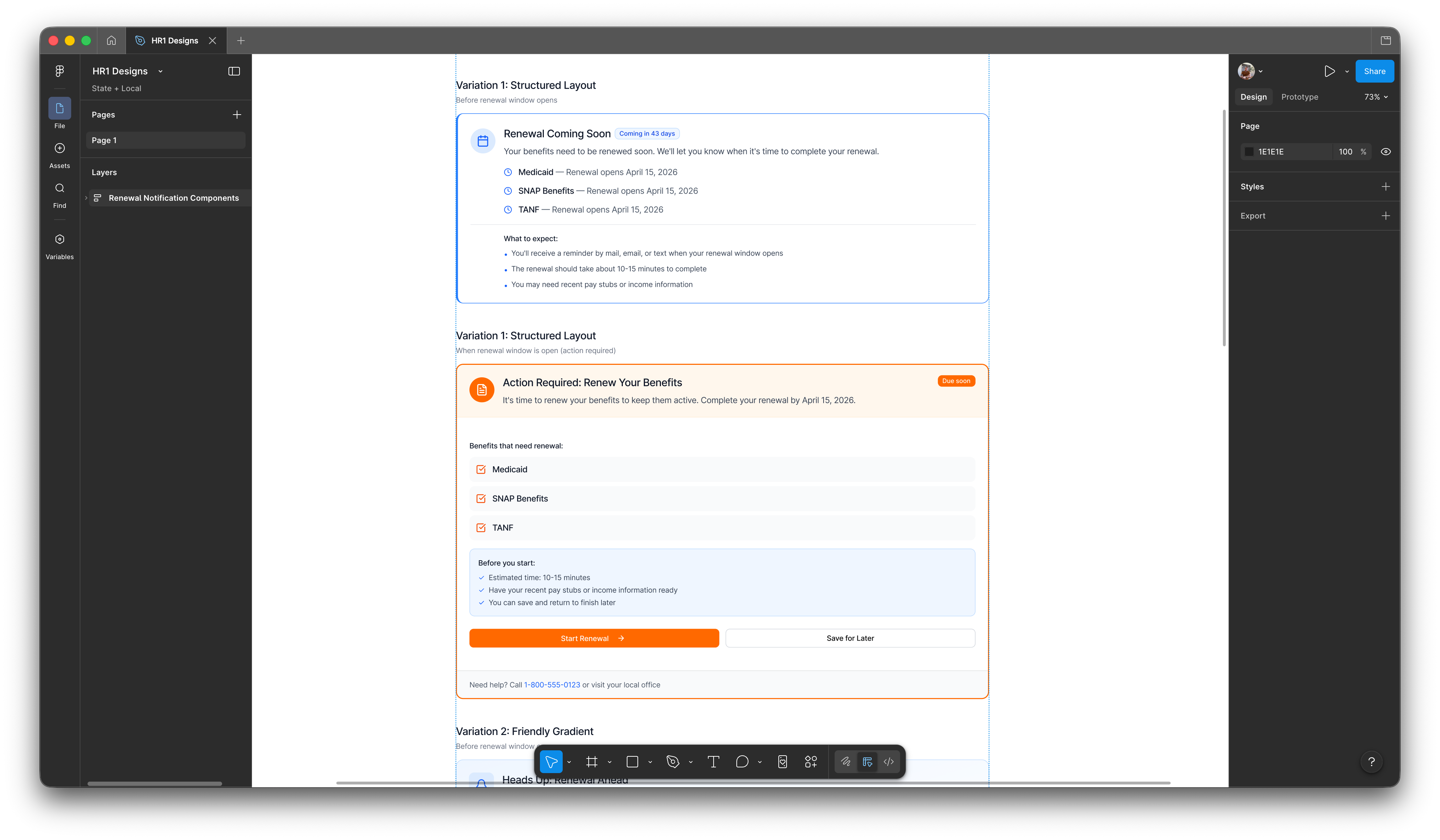
To address this, our team iterated by designing a personalized, dynamic compliance dashboard within the state's authenticated online benefits portal . This self-service dashboard clearly displayed a client's status, exemption reasons, and next steps, providing a secure environment for action while reducing the need for caseworker intervention.
Outcomes
By focusing on actionable operational levers, the team designed practical interventions aimed at increasing automatic verification and reducing manual caseworker reviews .
The resulting SMS strategy and portal dashboard prototypes provided the state with a clear, user-tested pathway to communicate early and effectively with beneficiaries .
Furthermore, the modular design of the compliance status indicators ensured that the state could scale these self-service patterns to other benefit programs, preventing long-term technical debt and supporting systemic burden reduction across the agency .